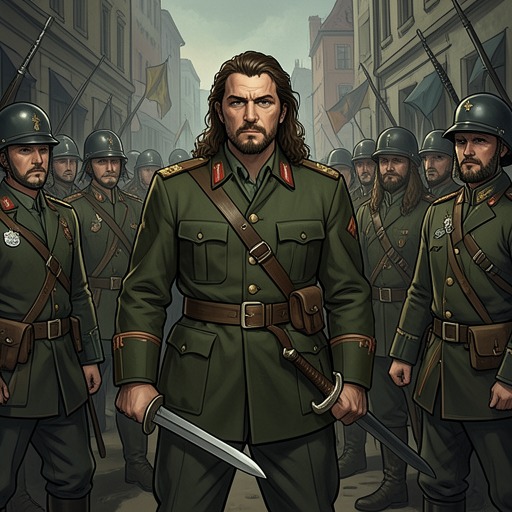
French forces
Cyrano de BergeracFrench forces are portrayed at Arras not as an unconstrained army but as besiegers whose position has become perilously vulnerable. Their predicament is defined by a double pressure: they are conducting a siege while themselves trapped by the Cardinal Infante of Spain, and their ability to endure depends on food, troop movements, and the limited resources still at camp.
Position at Arras
The French forces are besieging Arras when Le Bret describes the reversal at the heart of their situation: the besiegers have themselves been caught in a trap and besieged by the Cardinal Infante of Spain. The siege therefore entails more than an advance against a fortified objective; the French must also withstand an encirclement that threatens their own camp.
The crisis is material as well as strategic. Carbon calls it disgraceful that the troops should be starving while engaged in a siege. Hunger is not incidental hardship in this account: it exposes how dependent the army is on supply and sharpens the danger of being surrounded.
Supplies and the Missing Troops
Count de Guiche reports that the previous evening the Marshal made a final attempt to victual the army. He secretly went to Dourlens, where the King’s provisions were held, and took a substantial force of troops with him to make the return to camp easier. The provisioning effort thus created a consequential weakness: half the army is absent from camp.
Count de Guiche recognizes the risk in that absence. If the Spaniards knew how many French troops were away, they would have an opportunity to exploit the camp’s reduced strength. The effort to secure provisions and the danger of leaving the camp depleted are bound together: the army needs supplies to withstand the siege, but obtaining them draws forces away from the position they are meant to defend.
Food and Defensive Resources
Roxane’s arrival brings food into the scene of deprivation. She says the camp air has made her hungry too and orders pasties, cold fricassee, and old wines to be brought. Her request places the comforts of a meal against the soldiers’ reported starvation, though the evidence does not establish how widely the food is distributed.
Count de Guiche also identifies a remaining defensive resource: he has had one cannon carried to a corner, where the men can use it if necessary. The weapon is presented as a contingency rather than a gun already fired. Together, the food and the cannon make the army’s immediate circumstances concrete: sustenance is urgently needed, half its strength is away seeking provisions, and the camp’s available firepower is reduced to a single cannon specifically mentioned as ready for need.